Why Do Crystals Form Different Shapes? A Guide to Crystal Systems
Pick up a cube of fluorite from Weardale and a six-sided quartz prism from the Cairngorms, and the difference seems obvious. Both grew from solutions or vapours, atom by atom, yet one is square and the other has six sides. The reason lies in the internal arrangement of atoms — and in the seven crystal systems that describe it.
That short answer, though, hides a genuinely useful idea. The shape of a crystal is not a coincidence of chemistry or a quirk of the mine it came from. It is a direct readout of an invisible architecture, repeated billions of times. Learn to read that architecture and you can identify minerals, predict how they will break, and understand why the same species can turn up looking like two entirely different things.
What the seven systems actually describe
A crystal system is a shorthand for the symmetry of a repeating three-dimensional pattern. To describe any crystal, crystallographers use three axes — conventionally labelled a, b and c — and three angles between them: alpha (between b and c), beta (between a and c), and gamma (between a and b).
That is only six numbers. But by varying whether the axes are equal in length and whether the angles are 90°, you generate exactly seven possible arrangements — and no more. Every crystal ever found, from a grain of snow to a two-tonne beryl, belongs to one of them.
The seven systems at a glance
- Cubic — all three axes equal, all angles 90°. Examples: fluorite, halite, pyrite, garnet, diamond.
- Tetragonal — a equals b but not c, all angles 90°. Examples: zircon, rutile, cassiterite.
- Orthorhombic — all three axes different lengths, all angles 90°. Examples: olivine, topaz, barite, aragonite.
- Monoclinic — all three axes different lengths, two angles 90° and one not. Examples: gypsum, muscovite mica, augite.
- Triclinic — all three axes different lengths, no angles of 90°. Examples: plagioclase feldspar, kyanite, microcline.
- Hexagonal — described with four axes: three equal axes lying in a plane at 120° to each other, plus one perpendicular to them. Examples: apatite, beryl, corundum.
- Trigonal — often folded into the hexagonal family, but distinguished by threefold rather than sixfold symmetry. Examples: quartz, calcite, tourmaline.
That last point trips up plenty of collectors. Many textbooks list six systems and treat trigonal as a subdivision of hexagonal, because the two share the same axes. Treat it as a seventh if you want the full set; either way, the underlying geometry is the same.
The unit cell: where shape really begins
Every crystal is built from a unit cell — the smallest box of atoms that, repeated endlessly in three directions, rebuilds the entire structure. The outward shape is simply the unit cell written large, millions of times over.
Halite is the clearest illustration. Sodium and chlorine ions alternate on a grid of perfect cubes, each ion surrounded by six of the other. Grow that grid and you get a cube. Break it and it cleaves into smaller cubes, because the weakest planes run parallel to the faces.
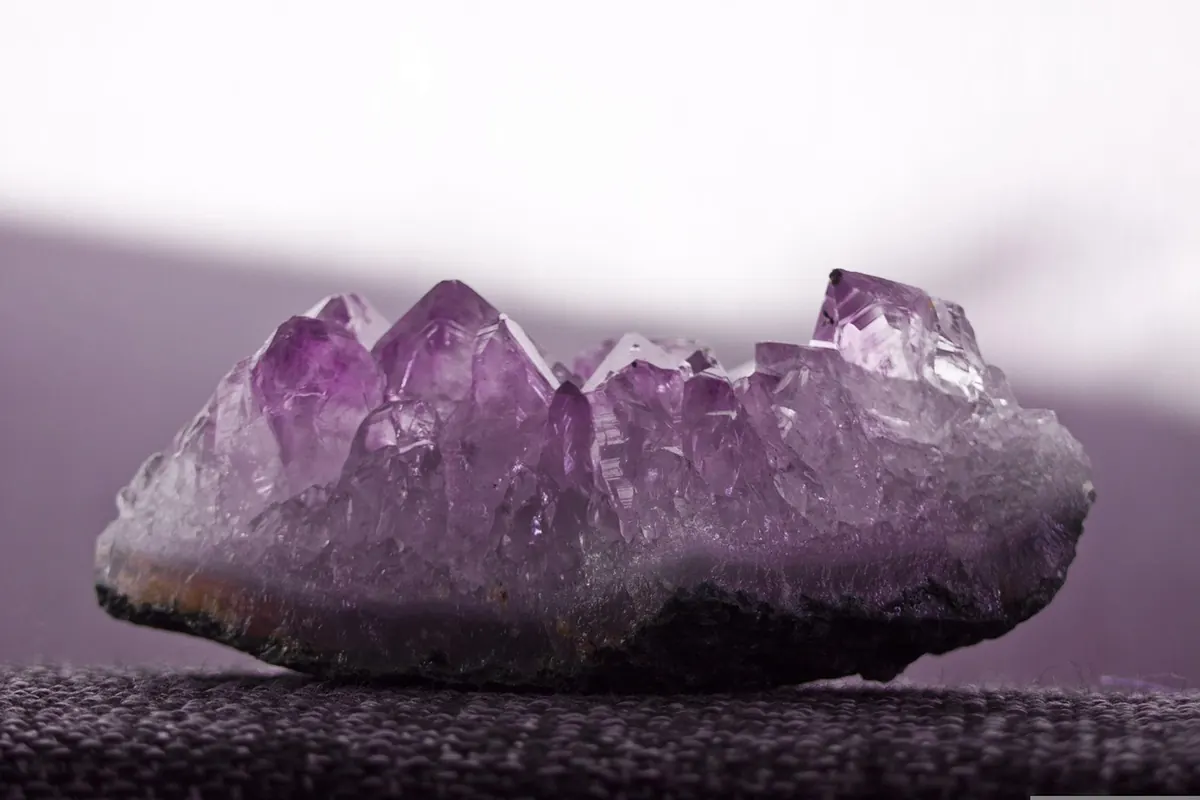
Quartz works differently. Its framework is built from silicon–oxygen tetrahedra linked into spiralling chains, with a screw axis running through the middle. That spiral produces the six-sided prism and pyramidal termination, and it also produces quartz's lack of a centre of symmetry — the property that makes a quartz plate generate a voltage when squeezed, and keeps your watch ticking.
System sets the maximum symmetry a crystal can have. Growth conditions decide how much of that symmetry actually shows up in the specimen on your shelf.
Habit versus system: why one mineral can look so different
The shape a crystal actually displays is called its habit, and habit is far more variable than system. Four factors do most of the work:
- Temperature and cooling rate. Slow cooling lets atoms find their preferred positions, producing clean, well-formed faces. Rapid cooling crowds them, giving skeletal or dendritic forms.
- Impurities. Trace elements can poison certain faces and let others grow faster, changing the whole outline. A pinch of lithium can turn a dull prism into a flat, tabular plate.
- Space. A crystal growing into open cavity has room to be perfect. One wedged between neighbours in a vein is forced into whatever gap is available.
- Medium. Crystals grown from a melt, a hydrothermal solution, or a vapour all behave differently, even when the chemistry is identical.
Calcite is the classic offender: it appears as rhombohedra, as sharp "dog tooth" scalenohedra, as nailhead spar, and as fibrous masses — all in the same trigonal system. Pyrite forms cubes, pyritohedra and octahedra, often on the same specimen. Quartz produces simple prisms, sceptre heads, Japan-law twins, and the banded cryptocrystalline material we call agate, whose crystals are too small to see at all.
Why the systems are worth knowing
Crystal systems are not an academic filing cabinet. They do real work:
- Identification. Nicolas Steno noticed in 1669 that the angles between equivalent faces on a quartz crystal are always the same, no matter how the crystal is distorted. Measuring those interfacial angles — constancy of interfacial angles — remains a reliable way to tell species apart when colour and habit have let you down.
- Predicting breakage. Cleavage follows lattice planes. Fluorite cleaves into octahedra, mica into sheets, halite into cubes. Knowing the system tells a lapidary which way a stone will split, and tells a geologist which fabric will control a rock's strength.
- Technology. Piezoelectric quartz, semiconductor silicon, and non-linear optical crystals all depend on specific symmetry classes. Removing a centre of symmetry is not a detail — it is the entire product.
- Structure determination. X-ray diffraction reads the unit cell directly, confirming a system in minutes where goniometry once took hours.
Working out a system from a specimen
- Look for repeated symmetry: rotational, mirror, or centre.
- Measure interfacial angles with a contact goniometer, or estimate them against a known face.
- Examine cleavage directions and the angles between them.
- Check optical behaviour — thin sections under crossed polars reveal symmetry quickly.
- Confirm with X-ray diffraction or a reference collection if the identification matters.
Back to Weardale and the Cairngorms. Both crystals grew by the same patient process, atom by atom, obeying rules that have not changed since the planet formed. The only difference is which of the seven patterns their atoms chose — and once you can recognise a system, a cabinet of minerals stops being a collection of pretty objects and becomes a set of diagrams you can read at a glance.